An LED power supply looks the same whatever it is rated for: a slim metal box with screw terminals. But a 5V, a 4.5V, a PFC and a common-cathode unit are built for different jobs, and fitting the wrong one is one of the most avoidable causes of dim, flickering or burnt-out screens.
This guide explains what each type is for, what goes wrong when they are swapped, and what to check before you order.
5V vs 4.5V: match the voltage on the module label
Most standard (common-anode) LED modules and receiving cards are designed for 5V. Some modules, often energy-saving indoor and fine-pitch designs, are specified for 4.5V instead. The module's datasheet or label tells you which.
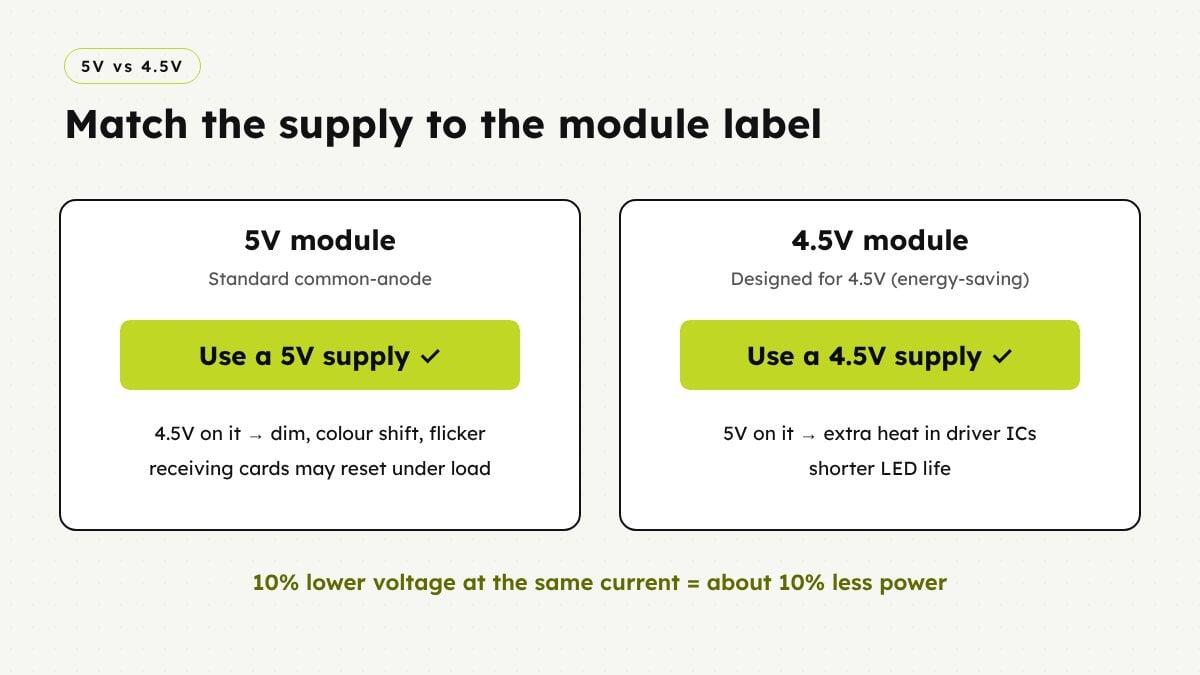
The gap looks small, but it is 10% of the voltage. At the same current, power drawn scales with voltage, so a screen built for 4.5V draws about 10% less at the supply. Module makers quote bigger whole-screen savings, 20–30%, but those figures are vendor claims without published test data (LSON).
A true 4.5V module is designed for it from the start: LED chips binned for a lower forward voltage and driver ICs that hold constant current at a lower knee voltage (LSON, Chipone via LEDinside). A 5V module run at 4.5V is not the same thing.
What goes wrong when they are swapped:
- 4.5V supply on a 5V module: not enough headroom for the LEDs and driver ICs. Expect lower brightness, colour shift on full white, flicker, or receiving cards resetting under load.
- 5V supply on a 4.5V module: the extra voltage turns into heat in the driver ICs. The screen may look fine on day one, but it runs hotter and LED life is shortened.
Rule: the supply voltage must match the module's rated voltage. Do not "tune" a 5V supply down or a 4.5V supply up to make it fit.
PFC vs non-PFC: how the supply behaves on your site's mains
PFC (power factor correction) is about the AC input side, not the DC output. A PFC and a non-PFC supply can both give a clean 5V or 4.5V to the modules; they differ in how they draw power from the mains.
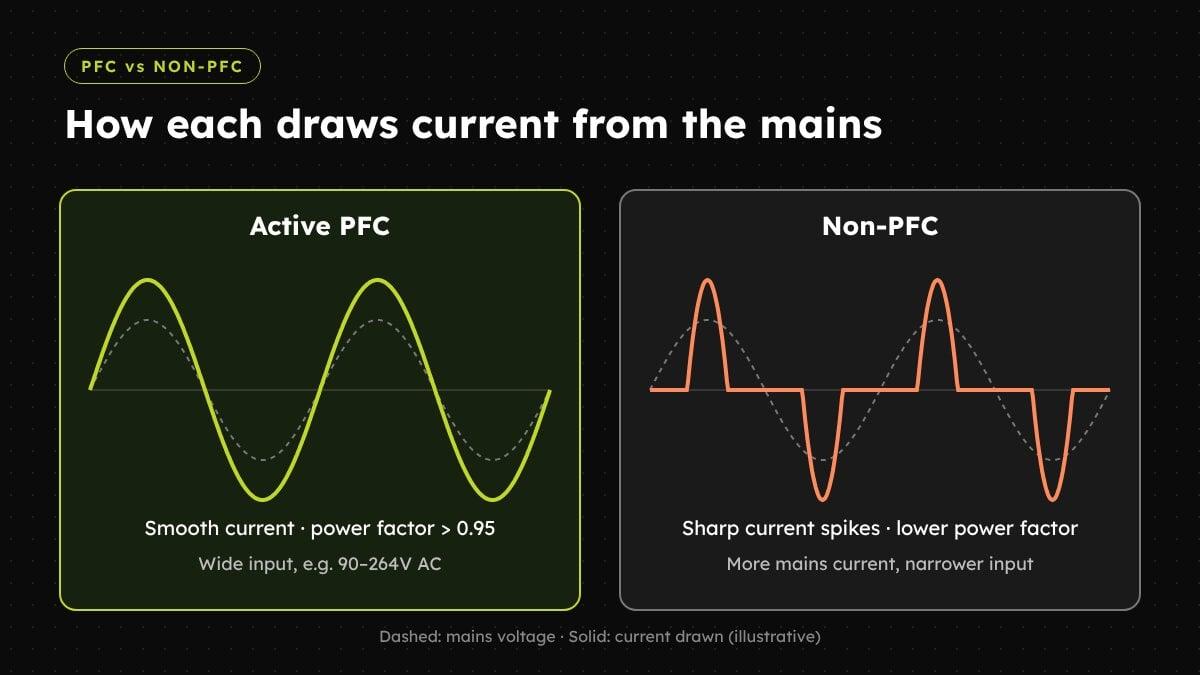
- Active-PFC supplies reach a power factor above 0.95 (MEAN WELL). They draw current smoothly, so the screen pulls less current from the mains for the same output. Most accept a wide input such as 90–264V AC, so they keep working when site voltage dips. That matters on generators, long cable runs and unstable supply.
- Non-PFC supplies draw current in short, sharp spikes. Passive-PFC units typically reach only 0.70–0.80 (Ideal Power), and units with no PFC sit lower. A low power factor means more current for the same useful power, so wiring and breakers carry more load. Many also need a narrower input, for example 180–264V AC on MEAN WELL's NEL-400-5 (Excelled). Below that, they cut out or reset.
Why not to mix them in one screen: breaker and cable sizing are worked out from input current, and the two types draw differently. Under a voltage dip, the non-PFC units drop out first while the PFC units stay on, so part of the screen goes dark. Use one type throughout a screen.
Common cathode: two voltages, not one
A standard common-anode module feeds red, green and blue LEDs from one shared rail, typically 5V. But red LEDs need only about 2.8V, while green and blue need about 3.8V. On a shared 5V rail, the surplus is burnt off as heat.
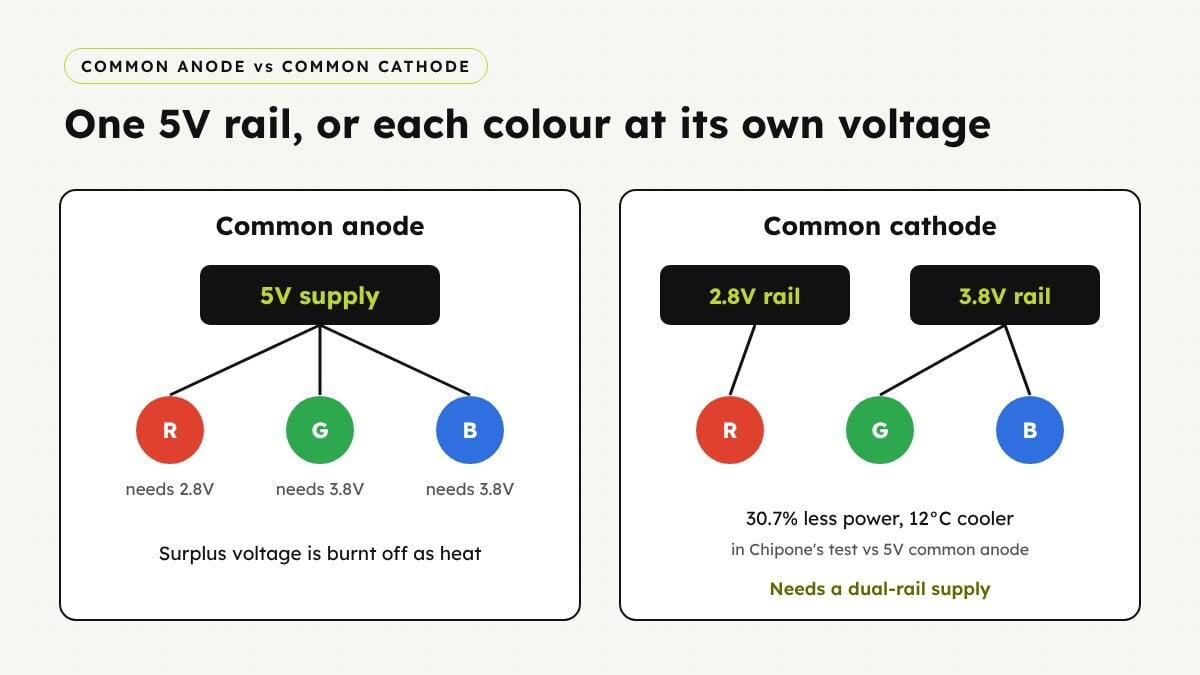
A common-cathode module powers each colour at the voltage it actually needs (Sekorm). So its power supply has two outputs, for example 3.8V for green and blue plus 2.8V for red.
In a test by driver-IC maker Chipone, a common-cathode setup drew 22.09W against 31.45W for the same 5V common-anode setup: 30.7% less. The LED surface also ran at 43.5°C instead of 55.9°C (LEDinside). Some sellers claim savings of 50–75%; treat those as marketing (MPLED).
Why these are never interchangeable:
- A common-cathode module needs a dual-rail supply. A single-output 5V or 4.5V supply cannot power it correctly, and putting 5V on a 3.8V or 2.8V input risks damaging the module.
- A dual-rail common-cathode supply cannot drive a standard common-anode module, which expects one 5V or 4.5V rail.
- The terminals differ too: a dual-rail unit has separate outputs for each voltage. Wire them exactly as the module's datasheet shows.
Rule: buy common-cathode supplies only for common-cathode modules, and confirm the module type before ordering.
At a glance
| Type | Output | Use it for | Input side |
|---|---|---|---|
| 5V | One rail, 5V | Standard common-anode modules rated 5V | PFC or non-PFC versions exist |
| 4.5V | One rail, 4.5V | Modules rated 4.5V (energy-saving builds) | PFC or non-PFC versions exist |
| Common cathode | Two rails, e.g. 3.8V + 2.8V | Common-cathode modules only | Check the input range on the label |
| Active PFC | Any of the above | Generators, long cable runs, unstable mains | Wide input, e.g. 90–264V AC |
| Non-PFC | Any of the above | Stable mains, cost-sensitive builds | Narrower input, e.g. 176–264V AC |
Voltage (5V, 4.5V or dual-rail) is set by the module. PFC or non-PFC is a separate choice, set by the site.
Before you order, check:
- Module type: common anode or common cathode?
- Module rated voltage: 5V or 4.5V (or the two rails for common cathode)?
- Site power: stable mains, or generator, long runs or voltage dips? If unsure, choose active PFC.
- Current: plan each supply to run at about 80% of its rated output, not 100% (Excelled).
- One type per screen: do not mix voltages or PFC and non-PFC units in the same screen.
Where to buy
Lumina stocks all three types ex-stock in Mumbai, with delivery across India:
- Active-PFC 4.5V: Hangte LPA-200-4.5 (40A) and LPA-300-4.5 (60A), fan-less, 90–264V input, 2-year warranty. See PFC power supplies
- Common cathode: Hangte LPH200D, 3.8V 30A + 2.8V 20A, 200W.
- 5V standard: CZCL, Leadpower and Qiangli BinaZk, 40A and 60A. See all power supplies
Not sure which one your modules need? Send the module model or a photo of its label on WhatsApp, and we will confirm before you order.
WhatsApp +91 97655 58000Shop power suppliesSources
Vendor figures (LSON, Chipone, MPLED) are the makers' own claims, not independent tests.
- What is power factor correction — MEAN WELL Direct
- Power factor correction in power supply units — Ideal Power
- Power supply for LED display board: 5V sizing rules — Excelled Display
- How to save 30% electricity with 4.5V LED design — LSON Display
- Energy-saving solutions for LED display drivers (Chipone) — LEDinside
- What are common cathode LED displays — Sekorm
- How is a common cathode LED display powered — MPLED